
Seminars
Casting a Differentiable Code Shadow: Bringing Legacy Earth System Models to GPUs via AI Translation
September 24, 2026
| 180 – 101 conference room & Microsoft Teams, 9:00 am PST
› view lecture
About this Lecture
The modernization of legacy Earth system models for GPU hardware is a major challenge, but large language models now offer a highly effective pathway for (semi-) automated code translation. In this talk, we discuss the recent development of FESOM2-JAX, a GPU-native, fully differentiable "code shadow" of the FESOM2 ocean-sea-ice model, translated from its Fortran original using an agentic LLM workflow. To guarantee rigorous scientific fidelity, the port was verified kernel-by-kernel, culminating in a 62-year climate hindcast that closely agrees with the original Fortran model. Moving to the Python JAX ecosystem delivers substantial performance improvements and hardware flexibility: the model runs the exact same source code unmodified from a laptop CPU up to 256 GPUs, with the 1-degree global configuration fitting on a single GPU, a four-GH200 node integrating ~113 simulated years per wall-clock day, and high-resolution meshes scaling up to 7.4 million surface vertices (~5 km spatial resolution). Crucially, the end-to-end differentiable time loop automatically generates exact adjoints without brittle source-to-source compilers. Ultimately, this differentiable framework enables rapid experimentation, gradient-based parameter calibration, and the seamless training of hybrid physics-machine-learning components, all while allowing validated developments to transfer directly back to the Fortran production model.
About
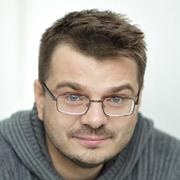
Dr. Nikolay Koldunov is a researcher at the Alfred Wegener Institute, Helmholtz Centre for Polar and Marine Research, specializing in physical oceanography with a particular focus on the Arctic Ocean and sea ice dynamics. His work centers on ocean and climate modeling, contributing to a deeper understanding of oceanic and atmospheric processes in both polar regions and on a global scale. Recently, Nikolay’s research interests have broadened to include AI-based weather and climate modeling, as well as high-resolution Earth System Models aimed at improving predictions of future climate variability. He is also exploring the potential of large language models (LLMs) for processing and disseminating climate information. Nikolay has authored over 60 peer-reviewed articles and actively collaborates with international teams to advance the field of ocean and climate science.