
Seminars
Gradients, benchmarks, and agents: a new toolkit for an old uncertainty
May 18, 2026
| 180 – 101 conference room & Microsoft Teams, 3:00 pm PST
› view lecture
About this Lecture
Human induced aerosols, such as sulphate, cool the Earth by reflecting some sunlight back to space. They also change the development and lifecycle of clouds which, in turn, regulate aerosols. Our current inability to accurately quantify these complex effects undermines our ability to attribute historical trends and accurately predict future climate changes.
Progress has been frustratingly slow, and I will argue this is partly a tooling problem: legacy codebases are architecturally mismatched with gradient-based learning and modern accelerators. Inspired by advances in machine learning, differentiable models written in JAX offer direct access to gradients, unlocking faster calibration and online bias correction from observations — and making the seamless embedding of ML components a natural next step rather than an afterthought. Combined with rigorous community benchmarks, and increasingly capable agentic coding tools that lower the barrier to building these systems, this may be opening a genuinely new path forward. I will share early results and an assessments of where this approach is promising, where the physics fights back, and what it might look like if it works.
About
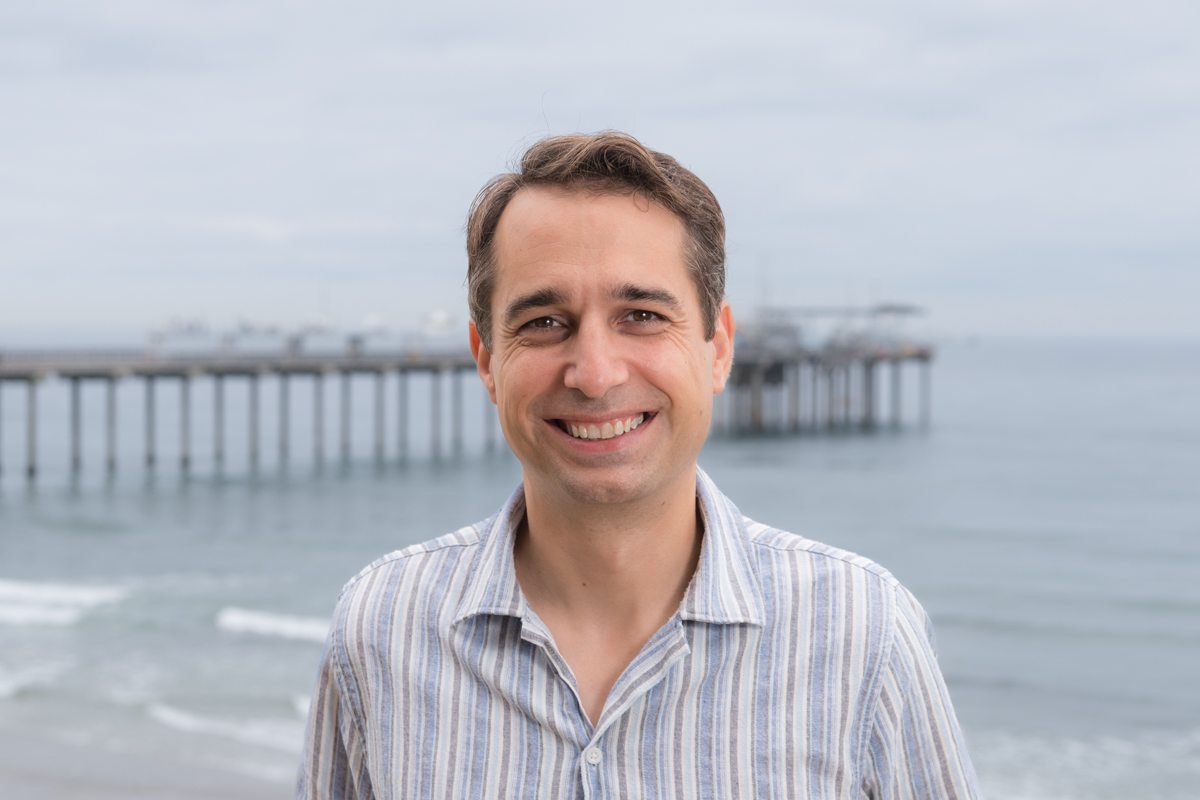
Duncan Watson-Parris is an Assistant Professor at Scripps Institution of Oceanography and the Halıcıoğlu Data Science Institute, UC San Diego, where he leads the Climate Analytics Lab. His research focuses on aerosol–cloud interactions and their representation in global climate models, combining satellite observations, machine learning, and differentiable modelling to reduce uncertainty in anthropogenic forcing. He is a lead developer of JEM, the first fully differentiable Earth System Model, and leads the GAIA Initiative at UCSD. His research is supported by an NSF CAREER award, a Google Academic Research Award, and DARPA.